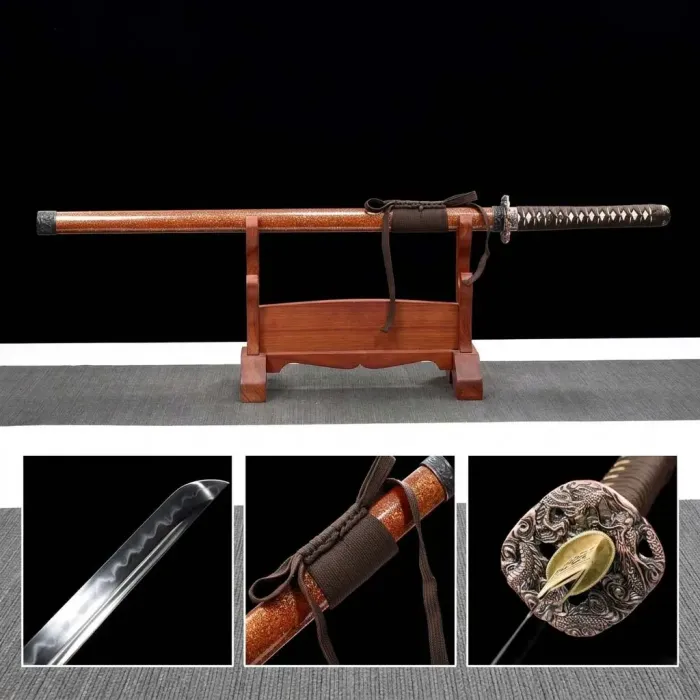
A time-honored samurai blade is a splendid creation of artistry, but think you wish for to exhibit your unique manner? Adapting your instrument is a meaningful journey, allowing you to craft a truly singular piece. From the hold wrapping and band to the covering design and blade pattern, each detail offers a chance for individual flair. This inquiry delves into the world of katana customizations, providing tips for both newcomers and proficient enthusiasts desiring to make their footprint on the classical art of the samurai.
Newcomer's Legitimate Skill
For those hoping to embark on the satisfying journey of traditional blade practices , 1060 steel katanas deliver an prime entry point. This selected grade of carbon steel meets a golden mean between budget-friendliness and performance . While not quite as hard as upper-echelon steels, 1060 facilitates a moderate level of whetting, making it suitable for novices to master the essentials of cutting tool servicing and embrace the refinement of expertly made Japanese weaponry. It’s a outstanding choice for building experience without the financial burden of more sophisticated steels.
10# Steel Swords : Finding Quality and Cost
To help hobbyists seeking an authentic sword experience without exceeding the budget , T10 alloy katanas represent a compelling option. These weapons offer a significant improvement in robustness compared to middling alternatives, exhibiting satisfactory edge retention and tolerable flexibility for elementary severing techniques. While not rivaling the outstanding characteristics of top-tier steels like T100 or folded metal , T10 provides a effective blend of capacity and reasonableness , making them a trendy choice for novices and those on a restrained funds.
Moving beyond the Keel : Tailoring Your Sword's Attachments and Haft
Whereas the honed blade is undeniably the key point of a katana, truly amplifying its aesthetic lies in the detailed customization of its accessories and grip . This operation allows admirers to showcase their special manner . Think about the comprehensive possibilities: menuki - decorative charms that introduce visual attraction ; the hamon enclosures – often elaborately molded ; the tsuka basis itself, wrapped in authentic ito binding ; and the fusa butt cap , which can be constructed from various elements like treasures or ivory .
- Prefer concepts that echo with you.
- Test with distinctive elements .
- Concentrate on excellence for a durable statement .
The Charm of the Katana: Heritage, Workmanship, and Metal
Such katana retains a incomparable allure, steeped in ages of eastern history and practice . More than merely a tool of conflict , it's a sign of the samurai ethos – a fusion of expertise and command . Its development spanned many generations, with early cutting instruments evolving into the sleek-lined curvature and deadly edge we know today. The manufacture involved is truly impressive , requiring years of study to excel at . The process involves a elaborate folding of metal bloom, creating layers that improve the cutting edge’s flexibility and carving ability. Numerous schools of smithing arose , each with their individual secrets and styles for achieving the finest harmony and cleanness - a truly heavy pursuit.
- Early Katana forms
- The function of the nihonto in fighter culture
- Old-fashioned blacksmithing styles
Opting for the Suitable Steel for Your Oriental Blade Project: 1060 vs. T10
Electing the appropriate steel is crucially important for any weapon project, and the judgment between 1060 and T10 can be tough. 1060 is a regular American fabrication, offering a fair balance of resilience and sturdiness, rendering it somewhat easy to process. However, T10, a from Japan steel, usually boasts superior 1060 steel katana wear resistance and can perhaps achieve a elevated decisive hardness, although it can be significantly hard to process and requires accurate heat treatment. Consider your background and anticipated benefits: for a rookie, 1060 may be a easier starting point, while the expert smith might admire the supplementary qualities of T10.
- Ease of Operating
- Erosion
- Conclusive Strength
Realizing the Capability: Sophisticated Katana Tuning Practices
Becoming proficient in blade modification extends far beyond basic grinding. Serious experts are now exploring advanced techniques to truly discover a blade's hidden potential. This requires intricate work with the hamon, utilizing specialized products for differential heat treating and carefully nominating the contour of the hand guard to optimize balance and quality. Beyond purely functional modifications, artisans are increasingly focused on realizing unparalleled aesthetic charm, through complex etching and layered films that truly transform a katana into a masterpiece.
Transforming Basic Steel into Art: Building a 1060 Sword
The journey initiates with common 1060 material , a durable material far away the deluxe katana it will transform . Proficient bladesmiths utilize a sophisticated process of layering and hammering the raw steel, repeatedly firing it and pressing it to eliminate impurities and establish a consistent grain structure. This demanding process, often going on for months , builds the imperative strength and elasticity characteristic of a legitimate Japanese sword . Continued heat manipulations , including precise hardening and cooling , are fundamental to achieve the desired harmony of sharpness, persistence and magnificence.- Layering: Minimizes impurities and constructs grain structure.
- Constructing: Forms the steel into the initial blade form.
- Quenching: Controls the final hardness and flexibility.
The Continuing Pull of the Katana: Comprehensive Review of Metalwork and Tailoring
Each traditional katana stays a captivating symbol representing Japanese custom , its enticement far beating mere weaponry . Forged from a special steel and sometimes featuring intricate motifs , the procedure of creation itself is a esteemed art. Beyond the essential craftsmanship, the ability to reshape a katana - from the temperation to the grasp wrapping and sheath - allows for a truly individual statement for both enthusiasts and users alike. This fusion of time-honored steelwork and boundless personalization results in the katana's continued prominence across the planet .
